From art to surrender, the ropes may change, but the psychology never does.
The first loop of rope always feels the same, a soft pull, a quiet claim. The fibres press into skin, not harsh but deliberate, as if saying: “Don’t move now. This is where you belong.”
My breath always changes first, shallow, waiting. There’s no struggle, only the strange calm that comes when you realise control has left your body but not your consent.
For a moment, the world narrows to texture, breath, and heartbeat, the rope, his hands, and the decision to stay still, when your body realises it’s no longer yours to command, and somehow, that feels like freedom.
Readers Request
Welcome to Readers’ Requests, a new series where I explore topics sent in by you.
This week, a member asks:
“How does it make you feel being physically restrained? How does bondage feed into the psychology of submission for you?”
A beautiful question, and one that unravels more layers than rope ever could.
The First Knot
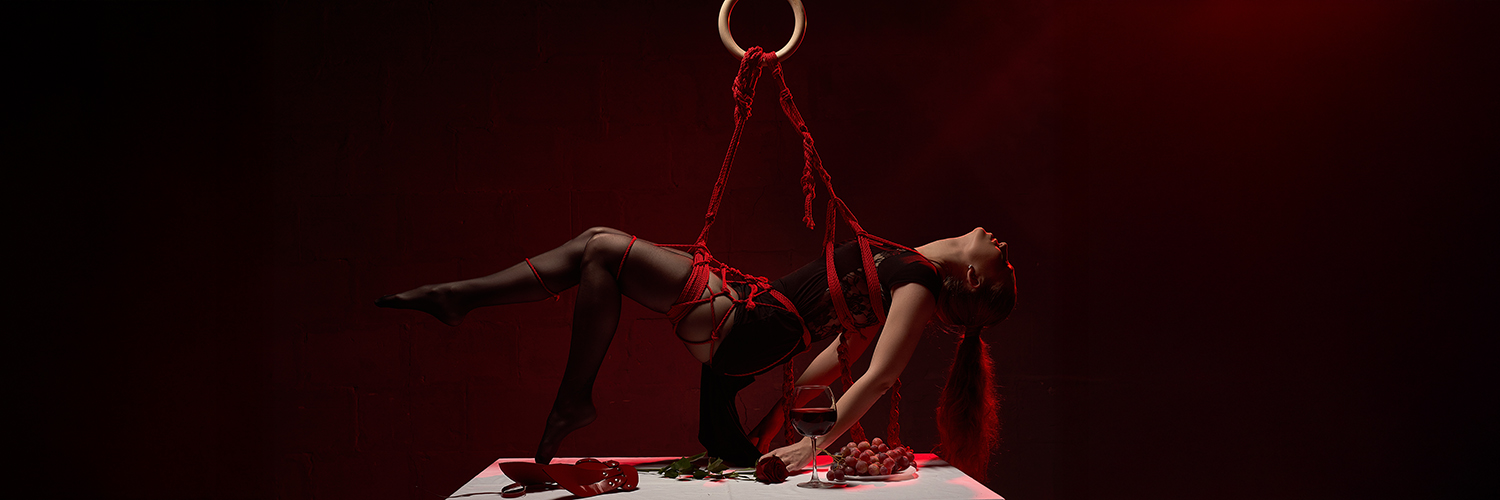
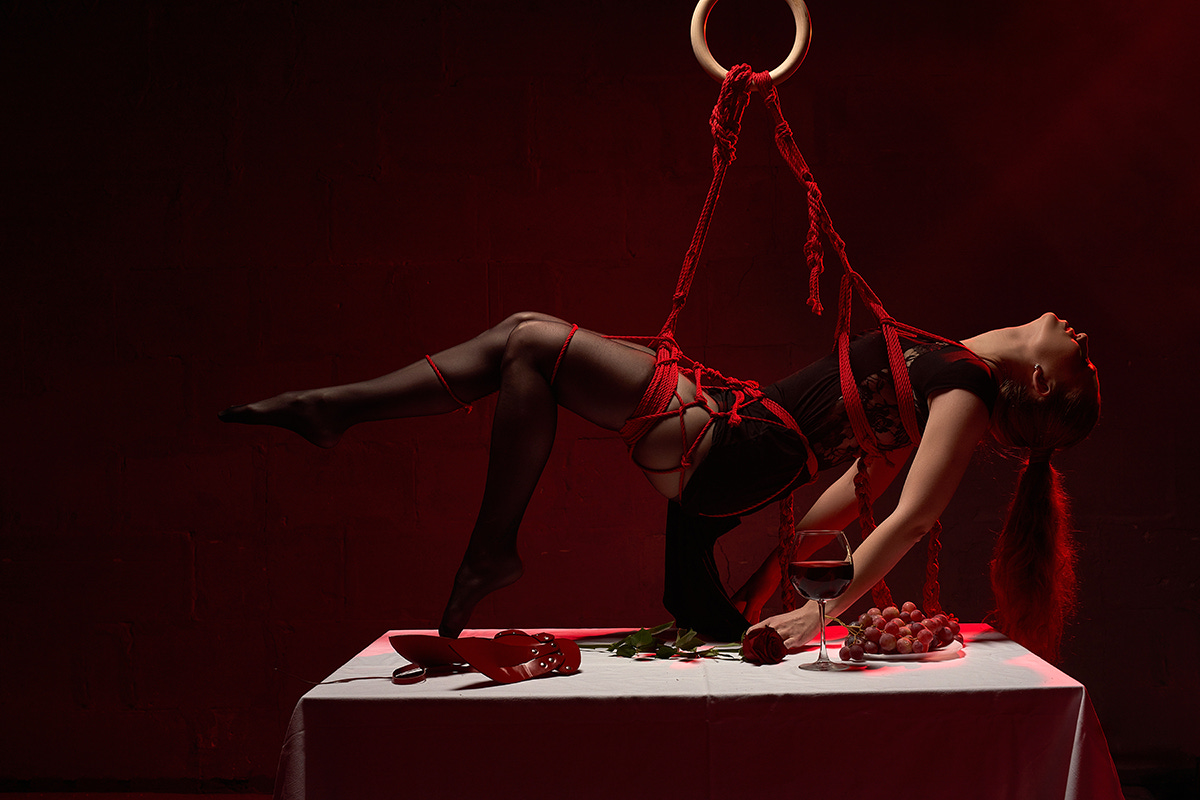
I’ve been suspended upside down from a wall, hung from a ring, wrapped in intricate webs, and bound in harnesses, mostly for artistic projects rather than play. I wouldn’t call myself an expert in rope or restraint, but I’ve experienced enough to understand its quiet power.
Restraint, in any form, has its own language. For some, it’s rope; for others, cuffs, fabric, or a steady hand. Entire communities exist around the artistry of binding, often without a sexual element at all. It can be art, meditation, or performance, an exploration of stillness and surrender.
The beauty is in its duality: it can be aesthetic or purely functional, a knot that looks like lace, or a tool that says, you stay there.
The Myth of the Rope Master
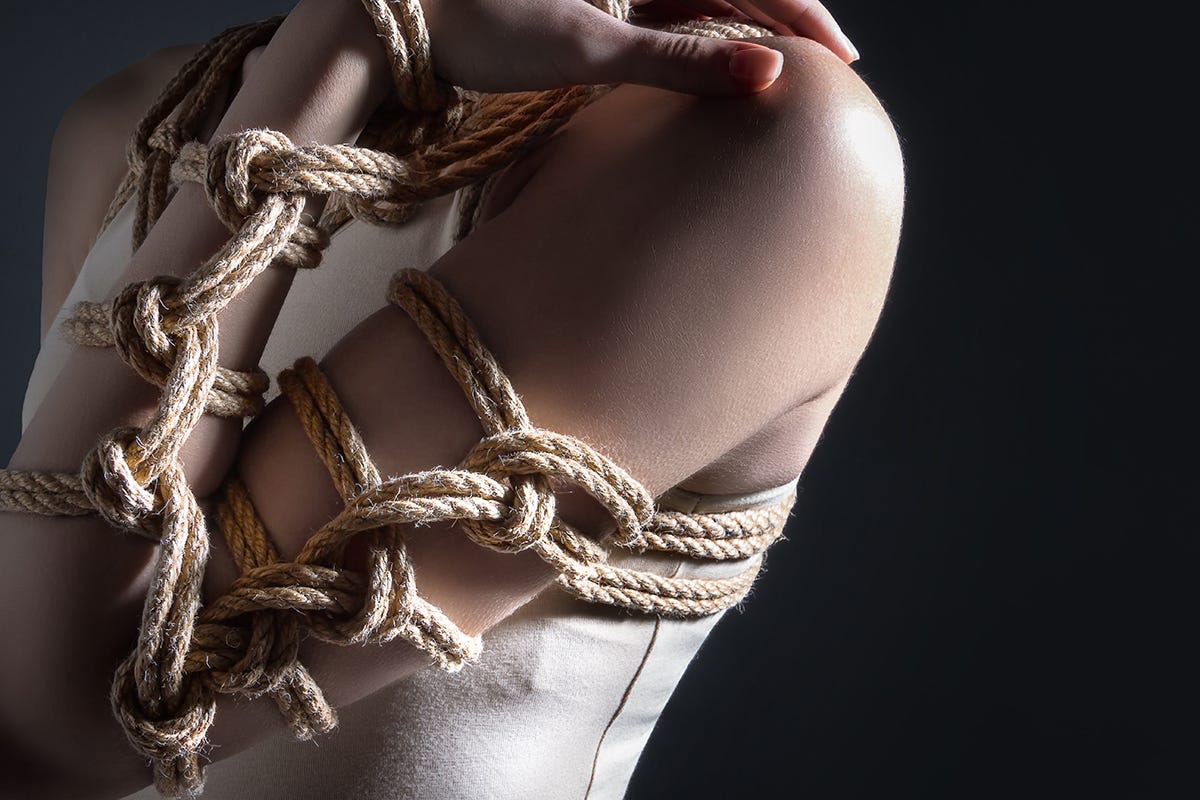
There’s a misconception that every Dom should be fluent in rope work, as if dominance were measured in knots. It isn’t. True riggers train for years; suspension and shibari are crafts, not shortcuts to control.
And the truth? Even the most intricate ties rarely last long. When I was hung inverted, naked, from a wall hook in a grand old Borough Market building, the setup took hours, but the actual suspension lasted less than ten minutes. It was for art, not sex, a still image after a long, patient build. You didn’t see the thick padding beneath the jute, or the quiet hands just off-camera, steadying me.
It hurt, a deep, focused hurt that lived in my ankles and in the blood rushing to my head. But beneath the discomfort, something else began to bloom: a strange quiet, an unspoken surrender. I had chosen this. I could have said no at any moment, but I didn’t.
In that surrender, vulnerability became its own kind of beauty, a deliberate, trembling act of trust.
The Art of Being Untied
Few people talk about the release, the untying, the slow, deliberate undoing. It’s an exquisite reversal, like time unwinding. You can sub-drop hard from bondage; the release can feel like falling through your own body. A good Dom knows this. They steady you, blanket you, or at least watch for the quiet wobble that comes with returning to gravity.
When you’ve been tied for a while, even in a simple body harness, the untying isn’t just practical; it can be deeply intimate. Each loosened knot, each soft brush of rope against skin, feels like a wordless conversation between the two of you. It’s the moment where dominance shifts back into care.
Sometimes, I’ve felt more erotically charged, more submissive, during the untying than the tying itself. There’s something about being released slowly, piece by piece, that feels like being seen. Every mark, every indentation, is proof that you gave over control and were safely returned.
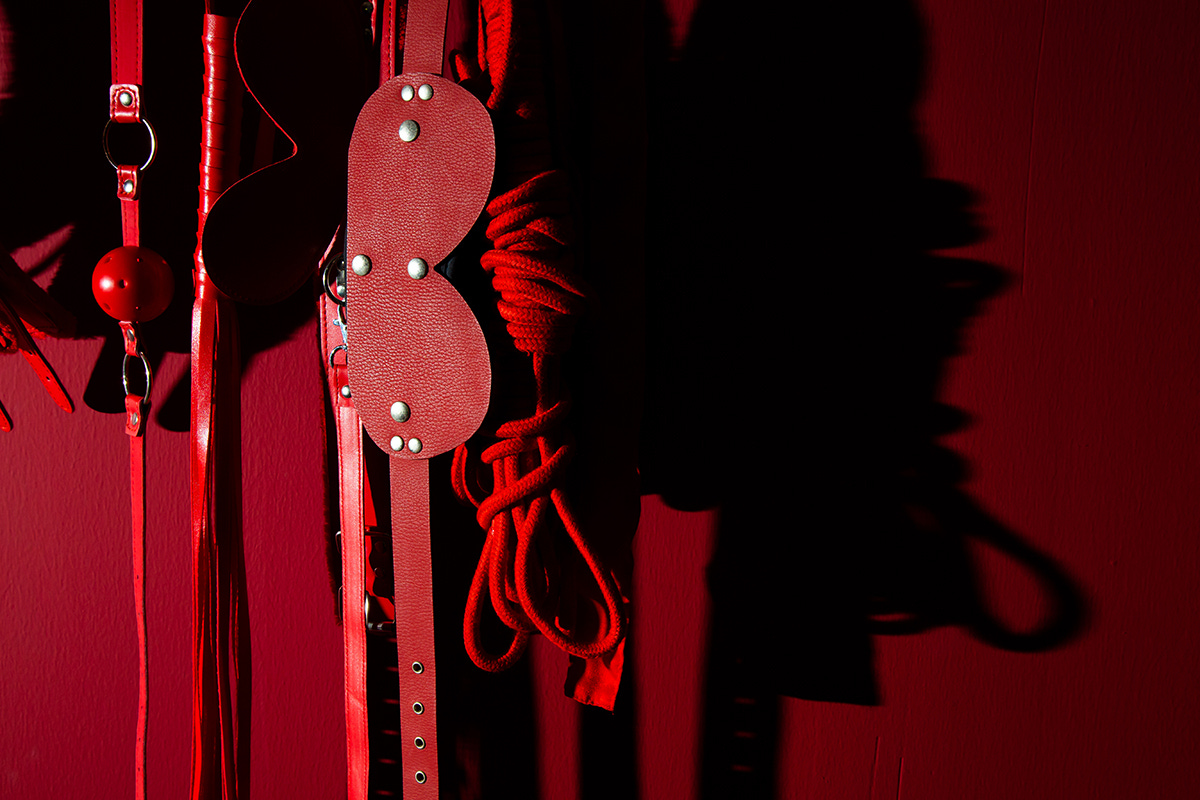
And then there are the rope or restraint marks, the little reminders, the keepsakes…
Fading love letters, written in jute and skin.
Between Art and Utility
Most of the intricate ties I’ve done were for art, photographs, or performance, moments created for beauty rather than pleasure. But equally beautiful are the simplest bonds: wrists tied to a bedpost, a soft rope looped loosely around your chest, or a Karada harness hidden beneath your clothes during an ordinary outing.
It isn’t the complexity of the knot or bind that matters; it’s the intent behind it.
When the rope or restraints bite too tightly and circulation fades, it stops being erotic. It becomes panic disguised as pain. The best bondage leaves you aware of the restraint, not consumed by it. You surrender into it, not to it.
I’ve met those who think tighter means better, that precision and pressure make it more “authentic.” But for a submissive, that kind of intensity can pull you out of the moment entirely. You start focusing on the burn, the pins and needles, the desperate shifting to relieve pressure. Rope, especially jute, self-tightens; what starts as control can easily slip into cruelty, even unintentionally.
Trapped nerves and numb limbs are the unspoken injuries of poor rope work. I’ve been lucky, but I have girlfriends who still carry faint tingles, the quiet aftermath of a scene gone wrong.
There’s also the emotional awkwardness of having to say, It’s too tight. Each time, it chips away at the trust and rhythm of surrender. The scene turns from something intimate into a negotiation that erodes power.
Instead of falling deeper into the moment, you start counting seconds until you’re released.
The most powerful bondage isn’t about endurance or pain. It’s about being held, safely, deliberately, in a space where both bodies know exactly what’s being exchanged.
The Suspension Ring
Most of my more elaborate experiences with rope have been for art. But once, I wanted to know how it would feel to be suspended from a ring, not for an image, not for a project, just for the experience itself.
My rigger was one of only a handful officially qualified in the UK at the time, a teacher as well as a practitioner. His calm confidence was its own quiet dominance. Trusting him felt both thrilling and terrifying in equal measure.
His studio, the “green room”, was lined with coils of black and red rope, soft and sharp against the dim studio lights. In the centre hung a single chrome suspension ring, gleaming like a promise. It was attached to a bespoke, reinforced beam designed to hold four or five times my weight, an impressive feat of engineering, though none of that logic helped the flutter in my stomach.
It felt like boarding a rollercoaster: you know you’re taking a risk, but you do it anyway, chasing that strange mix of fear and exhilaration. I told myself I wanted to know what it felt like to surrender completely, to experience helplessness as submission.
As he began to tie, the shift was almost imperceptible: one wrist bound, then a foot, then another, until the weight of my own body belonged to the rope, not to me. Suspended, I lost my bearings completely. There was no ground, no balance, no way to steady myself. I was aware of every heartbeat, every sway that wasn’t my own doing.
And then, stillness. The first few moments felt sharp, uncomfortable, almost too intimate. But slowly, a strange calm took over. My body stopped resisting gravity, and my mind followed. I wasn’t thinking about how I looked or whether I was performing submission; I simply was.
Suspension isn’t the soft restraint of being bound to a bed. It’s intense, disorienting, and at times, deeply uncomfortable. My body swayed slightly, pendulum-like, until he steadied me. There’s something almost humiliating in that movement, the helpless, involuntary momentum of your own weight.
But what I hadn’t anticipated was what happened after.
When the last rope came loose and my feet touched the floor, I felt light, almost euphoric. My body ached, yet I was calm, emptied and refilled at once. It was subspace, but delayed; I hadn’t even realised I’d gone there until I landed.
The Pull of Rope
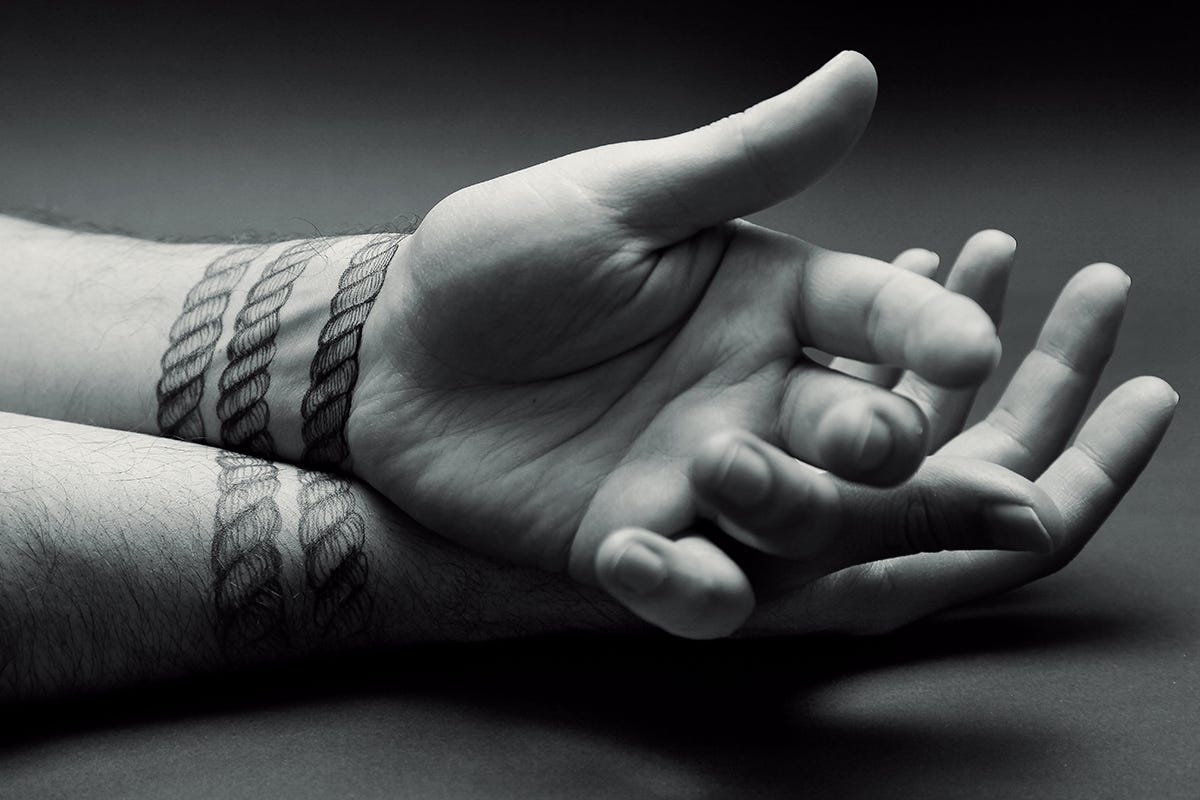
And still, rope remains a favourite, despite the many kinds of restraints available. There’s something tactile and deeply human about it, its immediacy, its intimacy. Rope feels alive in a way metal never can; it moulds to you, remembers you, and leaves its quiet marks behind.
Cuffs and ready-made leather binds might be easier, and as fun as they are, they’re rarely as expressive. Rope can be art or utility, elegant symmetry, or a single knot that simply says, Stay still.
It’s also wonderfully discreet, so innocuous in a travel suitcase or storage, rather than something resembling a kill kit.
Despite all the times I’ve been tied, I couldn’t tie even the simplest knot, nor do I want to. The beauty for me isn’t in the technique; it’s in the intent.
Whether you know the tensile strength of jute or your only experience comes from the “kinky aisle” of the local hardware store, rope, chain, leather, and metal are all inert things. What matters is the hands that use them, and what they mean when they do.
Why Restraint Feeds the Mind
For me, bondage has never really been about the rope or the bind. It’s about what it represents: being held, not trapped. Surrender without erasure.
The moment you realise you cannot move, something inside you shifts. The mind, finally, exhales.
Control gives way to trust.
That’s where submission truly begins.
Power in Patience
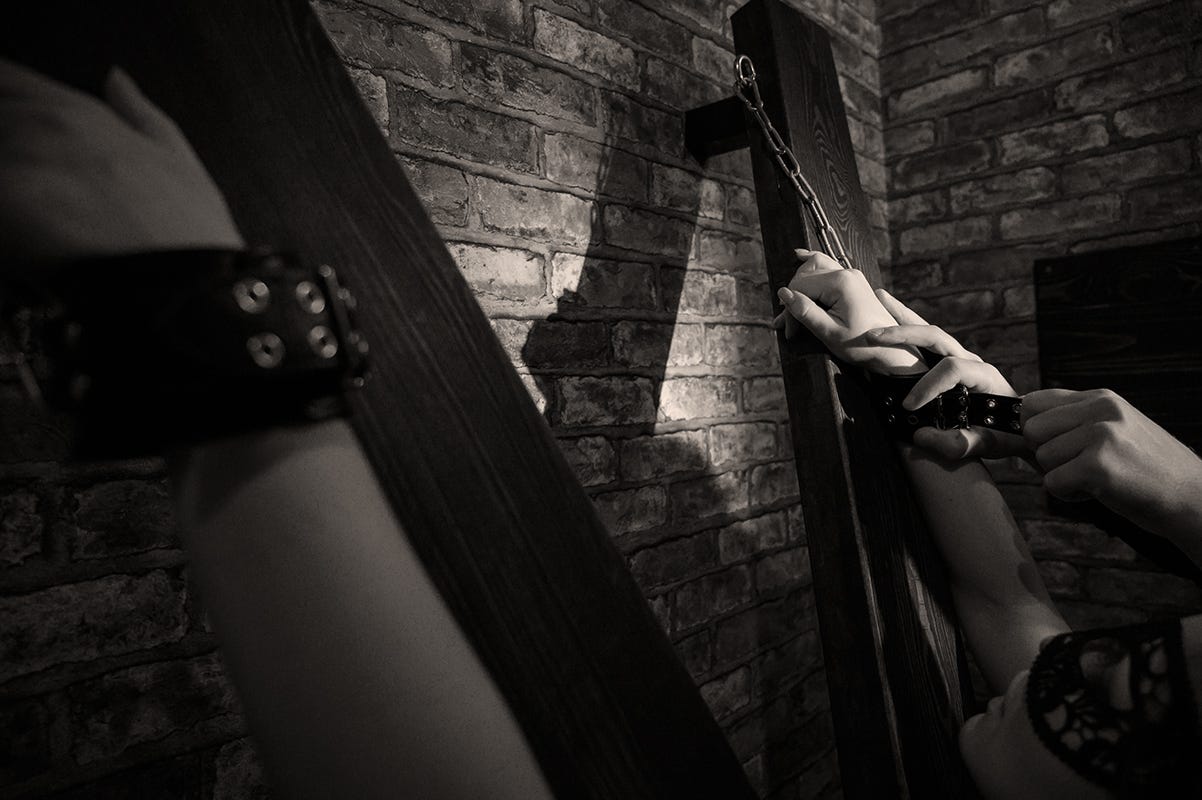
One of the most powerful Doms I’ve ever known rarely used rope or cuffs at all. He would simply hold my wrists, loosely, deliberately, just enough to remind me that he could. That near-weightless restraint carried more command than any knot.
Sometimes, it’s not what they do, but what they choose not to, in full awareness of the power they hold.
A friend once told me about a man she served. The first time, he took her by the wrist straight into the bath, stripped, restrained, washed, and used her until she was trembling. The second time, she arrived expecting something similar. Instead, he poured tea, fed her cake, and sent her home untouched.
She never knew what the third time would bring.
That is control.
True dominance doesn’t chase urgency; it builds tension. A Dom who can delay their own desire shows mastery.
Because self-restraint, both emotional and physical, is what earns devotion.
You cannot command surrender. You have to inspire it.
Where the Rope Ends
Bondage isn’t really about rope, cuffs, or rings. It’s about the quiet covenant between two bodies, a wordless exchange of trust. I trust you to take me somewhere I can’t go alone.
Because in the end, restraint is just the visible part of something invisible, the tension, the care, the faith.
The body is only ever the canvas. What binds us, truly, is trust.

Enjoyed this piece? Receive new posts directly in your inbox, for free or with exclusive members-only content.